
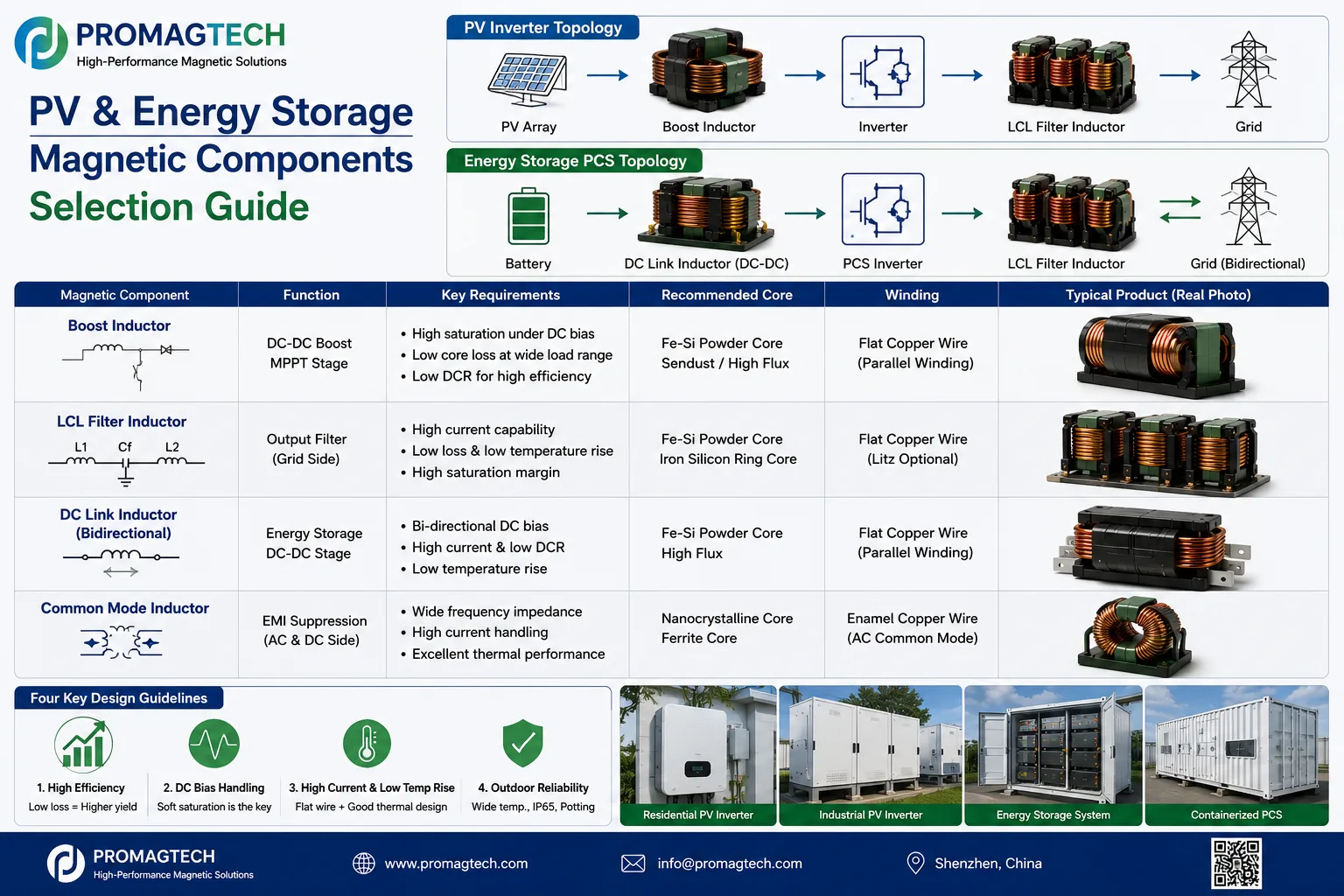
1. What This Reference Does
A PV chain commonly runs from array through boost, inverter bridge and LCL filter to the grid. An energy-storage chain runs from battery through bidirectional DC-DC, PCS inverter and LCL filter to the grid. This reference puts the magnetics at those nodes into one selection map.
2. Magnetic Positions and Binding Constraints
| Position | Magnetic | Binding constraints |
|---|---|---|
| PV boost stage | Boost inductor | DC bias, wide MPPT range, DCR and core loss |
| Inverter grid side | LCL filter inductors | Ripple loss, high current and saturation margin |
| ESS DC-DC | Bidirectional high-current DC inductor | Bidirectional bias, rise and current sharing |
| Isolation stage | HF or line-frequency transformer | Isolation, efficiency, size and cost |
| Full-chain EMI | Common-mode choke | Broadband impedance and high through-current |
3. Four Selection Axes
Efficiency: core loss affects light-load weighted efficiency while DCR affects high-load loss. DC bias: turns for boost, LCL and ESS DC inductors must use loaded inductance. Temperature rise: flat-wire and thermal-path choices require ΔDCR and hot-spot validation. Outdoor environment: wide temperature, humidity, salt fog, IP rating, potting and altitude derating belong in the DVP.
4. Application Quick Reference
String PV inverters typically prioritize boost and LCL efficiency. Residential PV-plus-storage adds size and acoustic limits. C&I PCS systems emphasize bidirectional bias, rise and current sharing. Utility or container storage adds serviceability, humidity, salt fog and long-term structural reliability.
5. Validation and Quality Baseline
A DVP should cover bidirectional DC bias, loss budget, ΔDCR and hot-spot rise, wide-temperature inductance/loss, 85/85 humidity bias, outdoor salt fog, thermal cycling, vibration and batch consistency. Acceptance values in the guide are examples and must be set per project.
6. Frequently Asked Questions
Why do PV magnetics care so much about light-load loss?
EU efficiency gives substantial weight to the 5-50 percent load range, with the 50 percent point weighted at 0.48. At light load, copper loss is lower and core loss becomes more important, so low-loss core material can materially affect weighted inverter efficiency.
Can boost and LCL inductors use the same core material?
Often they can both use powder-core families, but their operating points differ. Boost inductors are usually DC-bias driven, while LCL inductors require ripple-loss and saturation-margin review. The material family may match while permeability and structure differ.
What extra checks are required for a bidirectional energy-storage PCS?
Check DC bias and temperature rise in both charge and discharge directions and specify the worse direction. In paralleled systems, inductance consistency also affects current sharing.
Must outdoor magnetics be potted?
For an IP65 outdoor all-in-one system, potting is commonly used for moisture, vibration and heat transfer. The compound's thermal conductivity and coefficient of thermal expansion must match the core, winding and structure to avoid thermal-cycle damage.
How does solar and storage validation differ from 800V automotive magnetics?
The basic framework is similar: DC bias, temperature rise, insulation and batch consistency. Solar and storage emphasize outdoor humidity, salt fog, wide temperature and enclosure protection, while automotive programs emphasize the applicable AEC-Q200 Grade and mechanical stresses.
What can ProMagTech deliver for solar and energy storage?
ProMagTech can review boost, LCL and energy-storage high-current inductors, common-mode chokes and outdoor potting routes, then prepare a project-specific loss budget and DVP plan. Final scope and acceptance criteria depend on the submitted operating condition.
Download the English PDF Reference
Six-page English engineering reference, PMT-DOC-2026-0726-05, Rev A/0, dated 2026-07-26.
Download PDF Data