
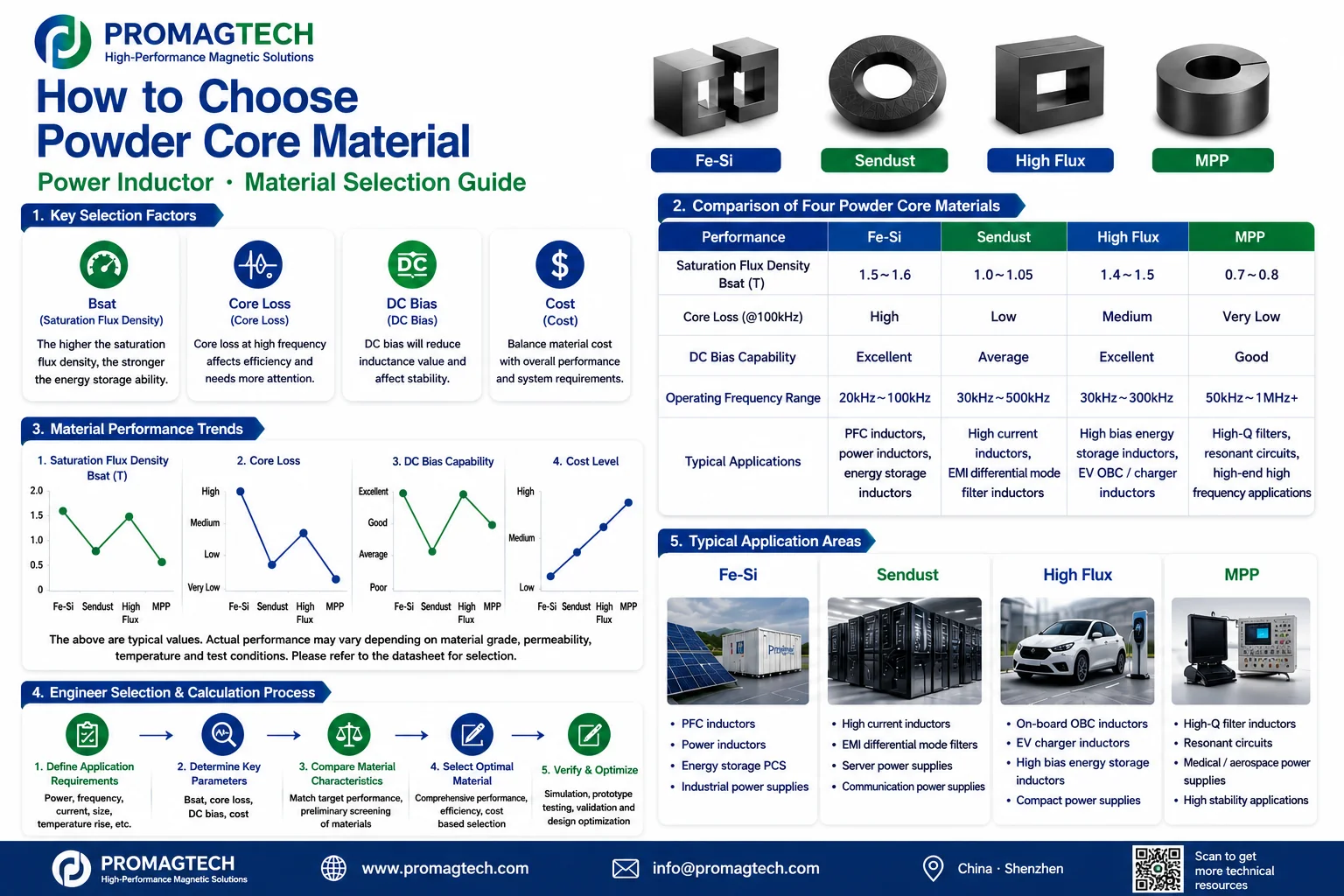
1. Start With the Operating Point
No powder-core family is universally best. The useful comparison is at the real operating point: required inductance under rated and peak current, ripple current, switching frequency, allowable temperature rise, size and cost. Material-family values are screening references; the selected grade and permeability must be checked against its datasheet.
2. Four Material Families
High saturation-flux capability and low relative material cost, with core loss requiring careful review.
A balanced option for loss, bias, acoustic behavior and cost in many PFC and filter designs.
Often evaluated where compact size and strong DC-bias retention are primary constraints.
Often selected for low loss, high Q and temperature stability when cost and bias limits permit.
3. DC Bias and Loss Must Be Checked Together
Use the selected grade's permeability-versus-magnetizing-force curve to estimate inductance retention under load. Then estimate core loss using the vendor's loss data at the actual frequency, flux swing and temperature. Initial permeability or initial AL alone is not sufficient for turns selection.
4. Engineering Selection and DVP
Define L, rated and peak current, ripple, frequency, thermal and mechanical limits; estimate stored energy; select material and permeability; calculate turns using biased AL; then iterate DC bias, core loss, copper loss and temperature rise. Sample validation should include inductance with DC bias, Isat definition, DCR, core-loss or temperature-rise evidence, batch spread and wide-temperature behavior as required by the project.
5. Frequently Asked Questions
Powder core or ferrite with a gap - how do I choose?
Powder cores are commonly evaluated when an inductor must store energy across a wide DC-current range and a gradual inductance roll-off is useful. Gapped ferrite may suit higher-frequency or lower-loss operating points. The choice must be checked against the required inductance under bias, ripple flux, loss, temperature and cost.
Why are powder cores often used in PFC inductors?
PFC inductors can operate with substantial DC bias and current ripple over a wide load range. A distributed-gap powder core can provide gradual inductance roll-off, but gapped ferrite is not automatically excluded; topology, frequency, energy storage, loss and thermal limits determine the final material.
Are Sendust and Kool Mµ the same thing?
Sendust describes the Fe-Si-Al material family. Kool Mµ is a Magnetics trade name for products in that family. Equivalent grades from different vendors are not automatically interchangeable because permeability, loss, bias curves and coating systems can differ.
High Flux and MPP both contain nickel - what is the difference?
High Flux is a nickel-iron family with relatively high saturation flux density and strong DC-bias capability. MPP is a nickel-iron-molybdenum family generally selected for low loss, high Q and temperature stability. Exact values depend on grade, permeability, frequency and temperature.
Does a powder core need an external air gap?
Usually not. Powder cores already contain a distributed gap. Adding a concentrated gap can introduce fringing flux and localized winding loss, so it should only be considered when a verified magnetic design requires it.
How do I quickly estimate inductance under DC bias?
Calculate the operating magnetizing force from turns, current and magnetic path length, then read the remaining permeability from the selected grade's DC-bias curve. Apply that ratio to the initial AL or inductance and verify the result with the vendor model and sample measurement.
Does high temperature affect powder cores?
Yes. Permeability, core loss and long-term stability vary with material family, grade, frequency and temperature. Wide-temperature designs should use the selected vendor's temperature curves and confirm inductance, loss and temperature rise on samples.
If permeability is the same, which material should I choose?
Equal nominal permeability does not make materials interchangeable. Compare DC-bias retention, loss at the actual flux waveform, saturation margin, temperature behavior, acoustic requirements, size, coating and cost before selecting a grade.
Download the PDF Selection Guide
Download the English 8-page guide with comparison tables, sizing procedure, DVP baseline and glossary.
Download PDF Data