
1. Application Context
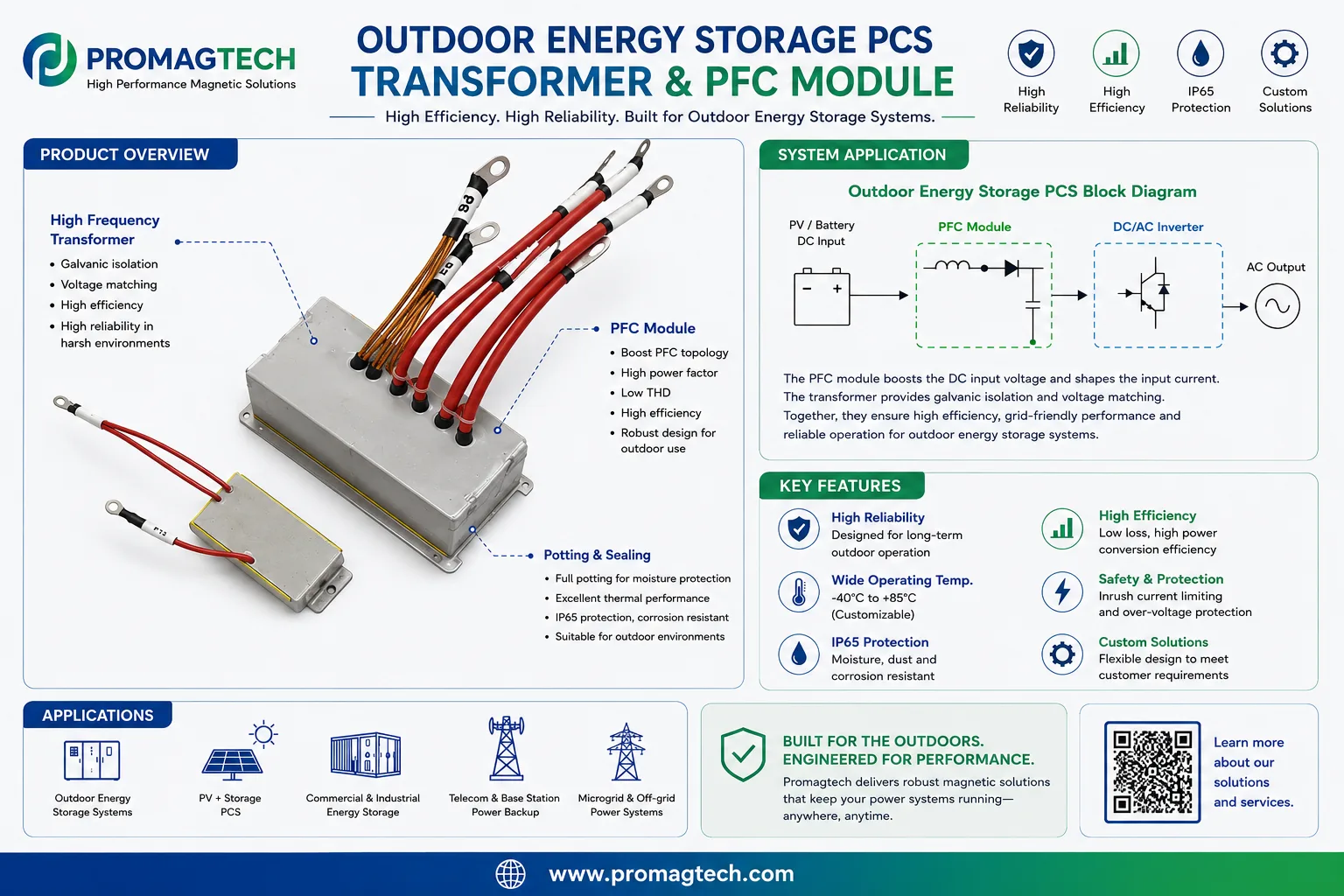
Outdoor PCS systems convert PV or battery DC input into grid or load-side AC output. In this path, the PFC module shapes input current and raises the DC bus, while the high-frequency transformer provides galvanic isolation and voltage matching where required by the system topology.
Unlike indoor cabinet electronics, outdoor ESS equipment must keep magnetic component performance stable under wide ambient temperature, moisture exposure, dust, vibration from installation environment and long operating hours.
2. Magnetic Component Review Points
Review isolation, voltage matching, winding structure, leakage target, insulation margin and thermal interface.
Review boost topology, current ripple, power factor target, THD requirement, DCR and copper loss.
Confirm full potting, moisture protection, corrosion resistance, heat path and service temperature range.
Treat IP protection, temperature rise, insulation, terminal structure and validation scope as linked design decisions.
3. Design Boundary for Outdoor PCS
The design target is not only high efficiency. For outdoor energy storage equipment, a magnetic component must also keep insulation, temperature rise and mechanical integrity within the approved project boundary. The same transformer or PFC magnetic module can behave differently when cooling method, enclosure airflow, potting material, cable routing or installation direction changes.
For this reason, ProMagTech recommends that engineers review magnetic components together with converter topology, DC input range, switching frequency, rated and peak current, thermal limit, enclosure requirement and qualification plan.
4. Parameters to Provide for Engineering Review
Input/output voltage, topology, frequency, power level, current waveform, ripple target and overload condition.
Size envelope, mounting method, terminal form, cable direction, potting requirement and enclosure constraints.
Ambient temperature, cooling method, maximum hot spot, duty cycle and expected service condition.
Inductance or turns ratio, DCR, hi-pot, insulation resistance, temperature rise and reliability test scope.
Download the PDF Data Guide
Download this ProMagTech outdoor ESS PCS magnetics design guide for internal design review and supplier discussion.
Download PDF DataRelated Engineering Resources
Energy storage inductor
Inductors for storage PCS, PV inverter and bidirectional DC-DC power stages.
Solar energy storage magnetics white paper
Magnetic component selection notes for PV inverters, storage PCS and bidirectional DC-DC stages.
Planar flat wire transformer
High-frequency transformer structures for compact isolated power conversion.