
1. Application Context
AI server power supply architectures keep moving toward higher current density and tighter mechanical envelopes. In the 48V distribution path, the DC-DC stage needs magnetic components that can carry high current, fit into compact power modules and remain manufacturable at scale.
2. Structure Reviewed in This Guide
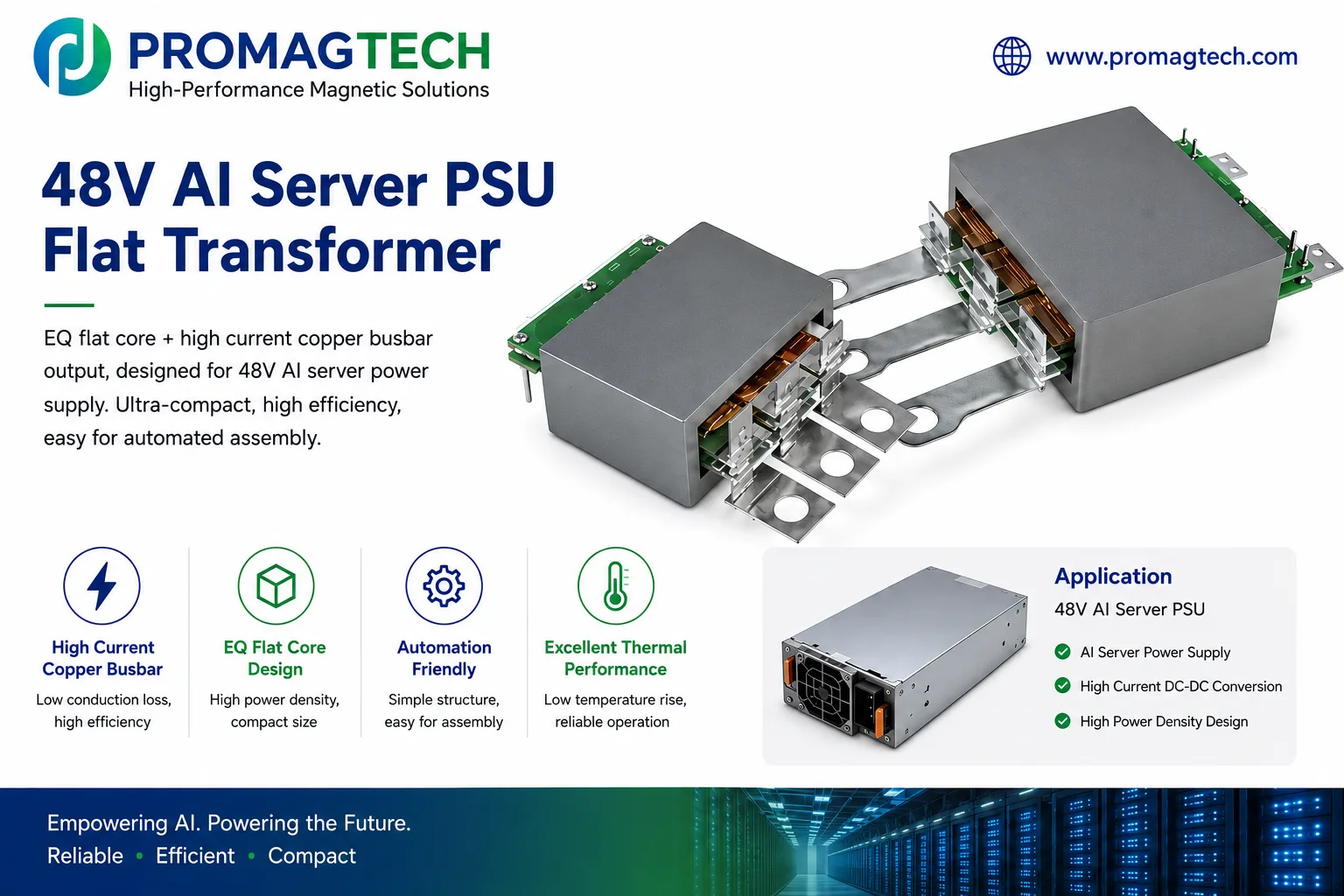
A flat magnetic structure helps reduce height and improve power density when the mechanical envelope is constrained.
The output path uses copper busbar geometry to lower conduction loss and support high-current DC-DC conversion.
A simpler, more repeatable structure supports fixture-based assembly and process consistency.
Low temperature rise requires reviewing winding loss, busbar loss, core loss, contact surfaces and airflow together.
3. Engineering Review Points
The review should include topology, switching frequency, input and output voltage range, power level, primary and secondary RMS current, copper busbar current density, insulation system, creepage and clearance, core material, winding layout, thermal interface and validation conditions.
For AI server PSU applications, a compact transformer that looks good in a drawing can still fail if high-current termination, hotspot location or assembly repeatability is not reviewed early. The practical question is whether electrical loss, heat path and production method remain aligned after the mechanical package is reduced.
4. Evidence Boundary
The public material shown here is a design guide and application illustration. Final transformer feasibility and performance must be confirmed against the customer topology, electrical specification, mechanical envelope, insulation requirement, cooling condition and sample validation data.
Download the PDF Data Report
Download the English 48V AI server PSU flat transformer guide for internal engineering review and supplier discussion.
Download PDF DataRelated Engineering Resources
IBC DCX transformer loss analysis
Review 48V to 12V transformer loss mechanisms in AI server power systems.
400kHz LLC transformer frequency knee
Compare frequency, loss, thermal stress and power density in high-frequency LLC transformer design.
Planar vs traditional transformer
Compare low-profile transformer design choices for high-frequency power supplies.