
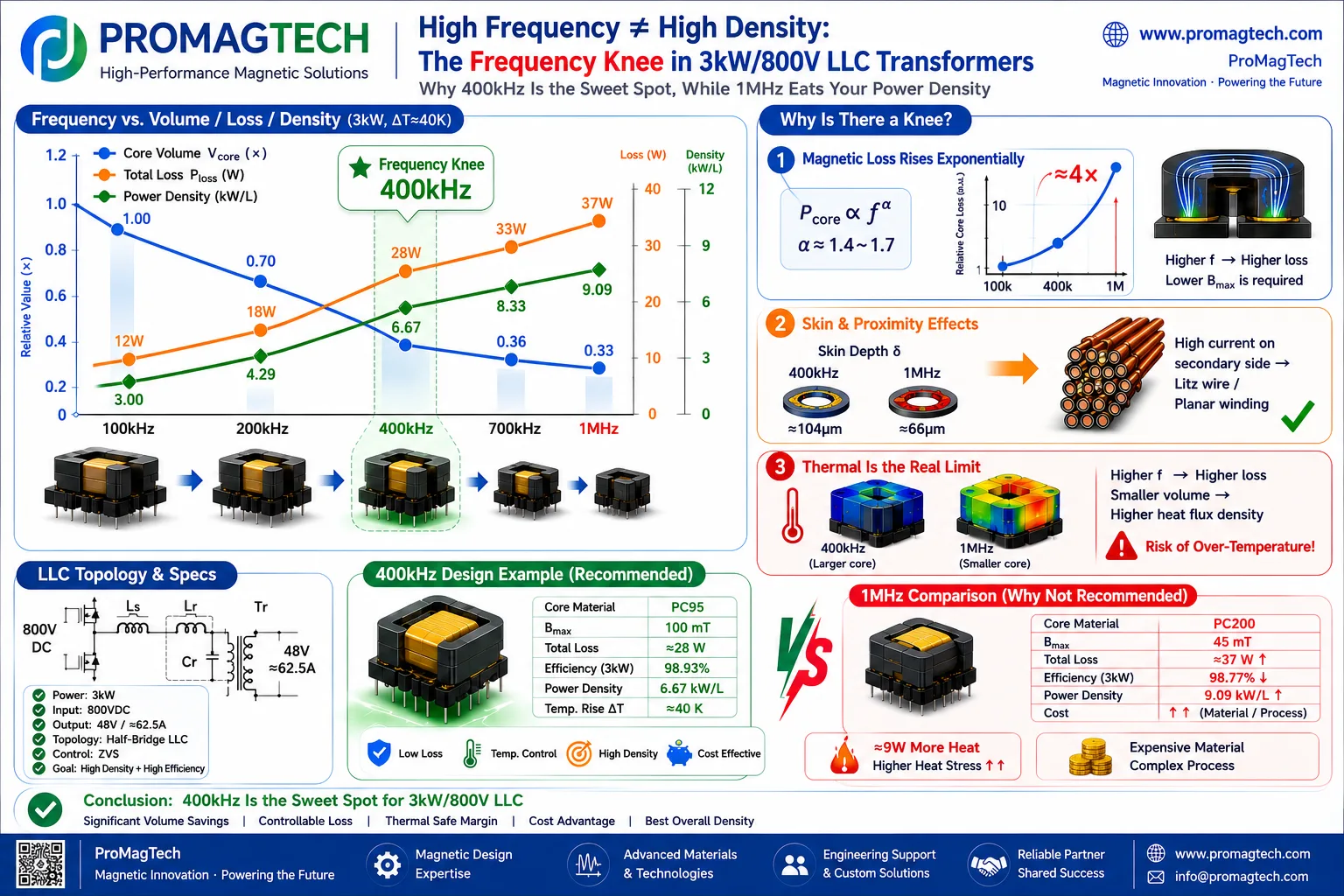
1. What the Frequency Knee Means
The frequency knee is the point where the benefit of smaller magnetic size starts to be offset by faster growth in loss, heat and manufacturing difficulty. For the example shown here, the practical balance appears around 400kHz, not at the highest possible switching frequency.
The analysis assumes a 3kW LLC transformer design context for an 800V battery system and a 400V output bus. Exact conclusions must still be validated against the converter topology, cooling method, winding construction, core material and sample test record.
2. Why 1MHz Can Lose Density in Real Hardware
The data sheet notes core loss scaling approximately with frequency exponent alpha around 1.4 to 1.7, so reduced flux density does not eliminate the loss penalty.
Skin effect and proximity effect become more severe, especially where secondary current and compact window geometry drive high copper loss.
The smaller part must dissipate more heat per volume. Thermal resistance and hotspot margin become design limits.
High-frequency materials, litz or planar winding structures and tighter process control can raise material and production cost.
3. 400kHz vs 1MHz Example Comparison
PC95 material, Bmax around 100mT, total loss about 28W, efficiency about 98.93%, power density about 6.67kW/L and temperature rise about 40K.
PC200 material, Bmax around 45mT, total loss about 37W, efficiency about 98.77%, power density about 9.09kW/L and about 9W more heat.
The 1MHz option can look better if the only metric is volume. It becomes less attractive when heat density, cost, secondary AC loss and validation risk are included. For many 3kW-class LLC applications, 400kHz can be the more robust design window.
4. Engineering Boundary
This resource should not be read as a universal rule that every LLC transformer should use 400kHz. The correct frequency depends on power level, input/output voltage, resonant tank design, semiconductor choice, core family, winding type, cooling method, insulation requirement and production process. The useful decision is to identify the system frequency knee before pushing frequency upward.
Download the PDF Data Guide
Download the English ProMagTech frequency-knee data sheet for engineering review and supplier discussion.
Download PDF DataRelated Engineering Resources
Planar flat wire transformer
High-frequency transformer structures for compact isolated power conversion.
Planar vs traditional transformer
Compare transformer structures by height, frequency, thermal path and EMI behavior.
Magnetic integration
Review integrated transformer and resonant inductor design for LLC and DC-DC converters.