
Whitepaper

Solar Energy Storage Magnetic Components Whitepaper

Key finding: Energy storage PCS magnetic components must be reviewed around bidirectional current, DC bias stability and thermal cycling, not only rated inductance.

1. Solar Energy Storage Market Overview With the acceleration of global energy transition, solar energy storage will usher in explosive growth. Solar inverters and energy storage converters (PCS) are core equipment in so...

Solar Energy Storage Magnetic Components Whitepaper
1. Solar Energy Storage Market Overview

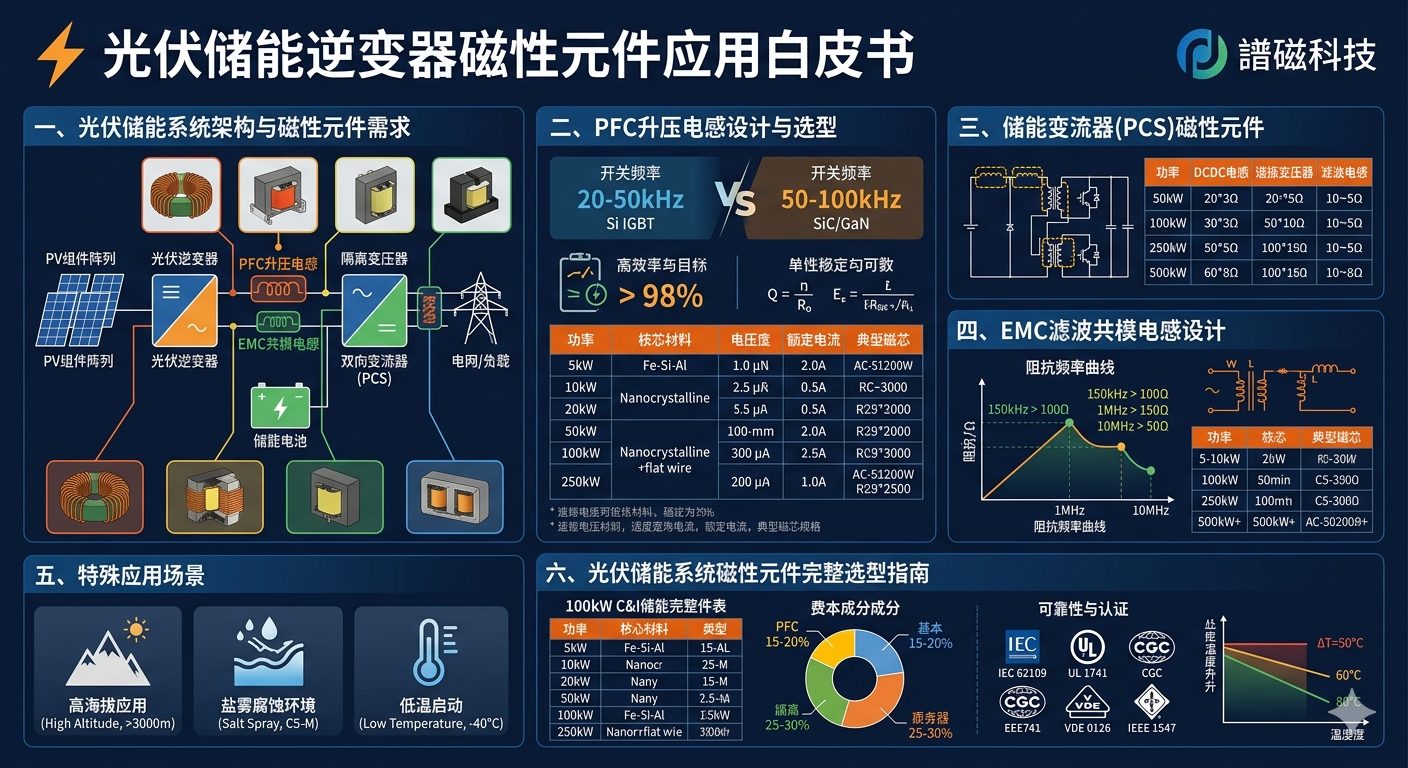
With the acceleration of global energy transition, solar energy storage will usher in explosive growth. Solar inverters and energy storage converters (PCS) are core equipment in solar energy storage systems, and their efficiency, reliability, and cost directly affect overall system performance. Magnetic components (inductors, transformers) are indispensable key elements in these power electronic equipment.

2. Solar Inverter Magnetic Components

2.1 Solar Inverter Topologies

String inverters are the market mainstream, power range 20kW-150kW, using two-stage structure:
• Front-end DC-DC (MPPT boost/buck): use boost inductor
• Back-end DC-AC (inverter): use common mode inductor, differential mode inductor

Micro-inverters power range 200W-500W, require high power density:
• High-frequency transformer is key component
• Planar transformer replaces traditional wound transformer

2.2 MPPT Boost Inductor Selection

MPPT boost inductor selection points:
• Power range: 20kW-150kW (string type)
• Operating frequency: 16kHz-50kHz
• Inductance calculation: L = (Vin × D)/(ΔI × fs)
• Core selection: Sendust or ferrite
• Efficiency requirement: ≥98%

3. Energy Storage PCS Magnetic Components

3.1 PCS Topology

Energy storage converters usually use DAB or MMC topology:
• DC-DC stage: bidirectional DC-DC inductor between energy storage battery and DC bus
• DC-AC stage: similar to solar inverter, inverter or rectifier

3.2 Bidirectional DC-DC Inductor Design

Bidirectional DC-DC inductor special requirements:
• Bidirectional power flow: charging and discharging conditions
• Power range: 100kW-500kW (commercial/industrial storage)
• Operating frequency: 8kHz-20kHz
• Efficiency requirement: ≥98.5%
• Cycle life: >6000 cycles (daily charge/discharge cycles)

Download the PDF Data Guide

Download this ProMagTech engineering resource as a PDF for internal design review and supplier discussion.

Download PDF Data
Ask ProMagTech Engineering

Related Engineering Resources

Energy storage inductor

Inductors for storage PCS, solar inverter and bidirectional DC-DC power stages.

Three-phase common mode inductor

Three-phase common mode chokes for inverter and storage converter EMI filtering.

20-60kW PFC inductor design guide

Selection and calculation notes for charging-station and industrial three-phase PFC inductors.

Frequently Asked Questions

What is the main engineering decision in Solar Energy Storage Magnetic Components Whitepaper?

The main decision is to match electrical stress, frequency, thermal path and mechanical envelope before confirming the magnetic component structure.

Which parameters should be provided for a custom review?

Provide input and output voltage, switching frequency, current waveform, target inductance or turns ratio, temperature limit, insulation requirement and mechanical drawing.

Can the values in this guide be used directly in production?

No. The values are design references. Production values should be confirmed through approved samples, DC bias checks, DCR measurement, hi-pot test and thermal validation.