
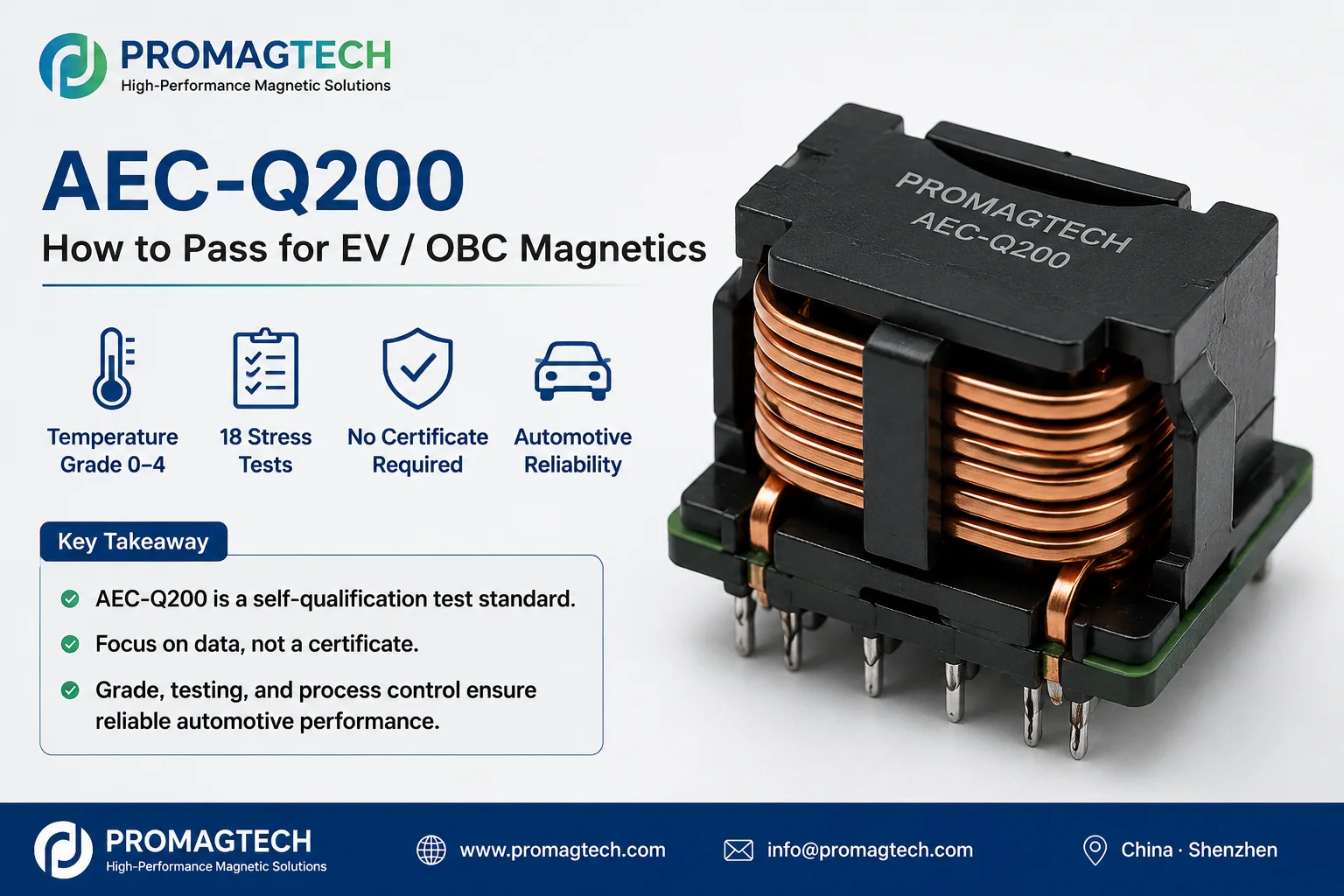
1. What AEC-Q200 Is - and Is Not
AEC-Q200 is a stress-test qualification framework for passive components, including inductors and transformers. It is not a third-party quality-system certificate and does not by itself prove that a factory or part number has customer production approval. Credible evidence is a part-specific qualification report covering applicable tests, conditions, sample sizes, criteria and results.
2. Select the Temperature Grade First
The vehicle program, mounting location and environmental requirement determine the Grade. Grade 1 is often used as a design reference for hot under-hood or OBC locations, but the current standard and customer specification control the final endpoints. Ambient temperature plus component temperature rise drives wire insulation class, bobbin, potting and life margin.
3. Applicable Stress Tests and Report Review
Compare critical parameters and drift before and after stress.
Review cycling, humidity, storage and operating life.
Review vibration, shock, terminals, joints and bonding.
Review solder heat, solderability, cleaning, flammability and dimensions.
The PDF groups magnetic-device requirements as 18 required or conditionally required tests. Each project must return to the current AEC-Q200 document, component category and customer qualification plan; the infographic count is not a substitute for the controlling matrix.
4. Magnetics-Specific Reliability Risks
Beyond the checklist, review wire insulation thermal class, bobbin and terminal materials, core and bond resistance to vibration, potting CTE, temperature-rise life, and reinforced insulation or partial discharge for 800V transformers. Passing one test campaign does not prove mass-production consistency.
5. Keep the Three Layers Separate
Component-level stress qualification and report.
Automotive quality-management system status.
Project planning, process evidence and customer production approval.
Buyers should also review material certificates, temperature-rise and life data, insulation or PD reports, lot traceability, PCN change control, and project documents such as PFMEA, control plans, MSA and process capability.
6. Frequently Asked Questions
Is AEC-Q200 a certification? Is there a certificate?
AEC-Q200 does not provide third-party certification or an official certificate. The supplier performs the applicable qualification tests and issues a report. Buyers should request the full report, test conditions, sample sizes, acceptance criteria and data.
Do inductors and transformers fall under AEC-Q200 or Q100?
Inductors and transformers are passive components and are addressed by AEC-Q200. AEC-Q100 and AEC-Q101 address active devices such as integrated circuits and discrete semiconductors.
Which Grade should OBC magnetics use?
Grade 1 is a common design reference for OBC magnetics in hot under-hood locations, but the final operating-temperature range must follow the vehicle program and the component location. The current AEC-Q200 revision and project specification control.
Does AEC-Q200 qualification alone approve a part for vehicle production?
No. Component qualification is only one layer. Automotive production also requires the applicable quality-system status, customer APQP and PPAP approval, traceability, change control and project-specific validation.
Where do automotive magnetics commonly fail?
Important risks include core or bond cracking during thermal cycling and vibration, terminal or solder-joint damage, insulation ageing during high-temperature operating life, moisture ingress and partial-discharge issues in high-voltage transformers.
Why is humidity-bias testing important?
Humidity with electrical bias can expose moisture ingress, corrosion, insulation resistance and leakage-current risks. The exact conditions and applicability must follow the current standard and the customer qualification plan.
What automotive reliability support can ProMagTech provide?
ProMagTech can support material and construction review for the target temperature range, temperature-rise and insulation or partial-discharge validation planning, and alignment of project-specific test data and production documentation. Qualification status must be confirmed from the actual report for the specific part.
Download the English PDF Guide
Download the 7-page English guide. PDF revision EN-1.0 is dated 2026-07-15; the web page was published on 2026-07-19.
Download PDF Data