
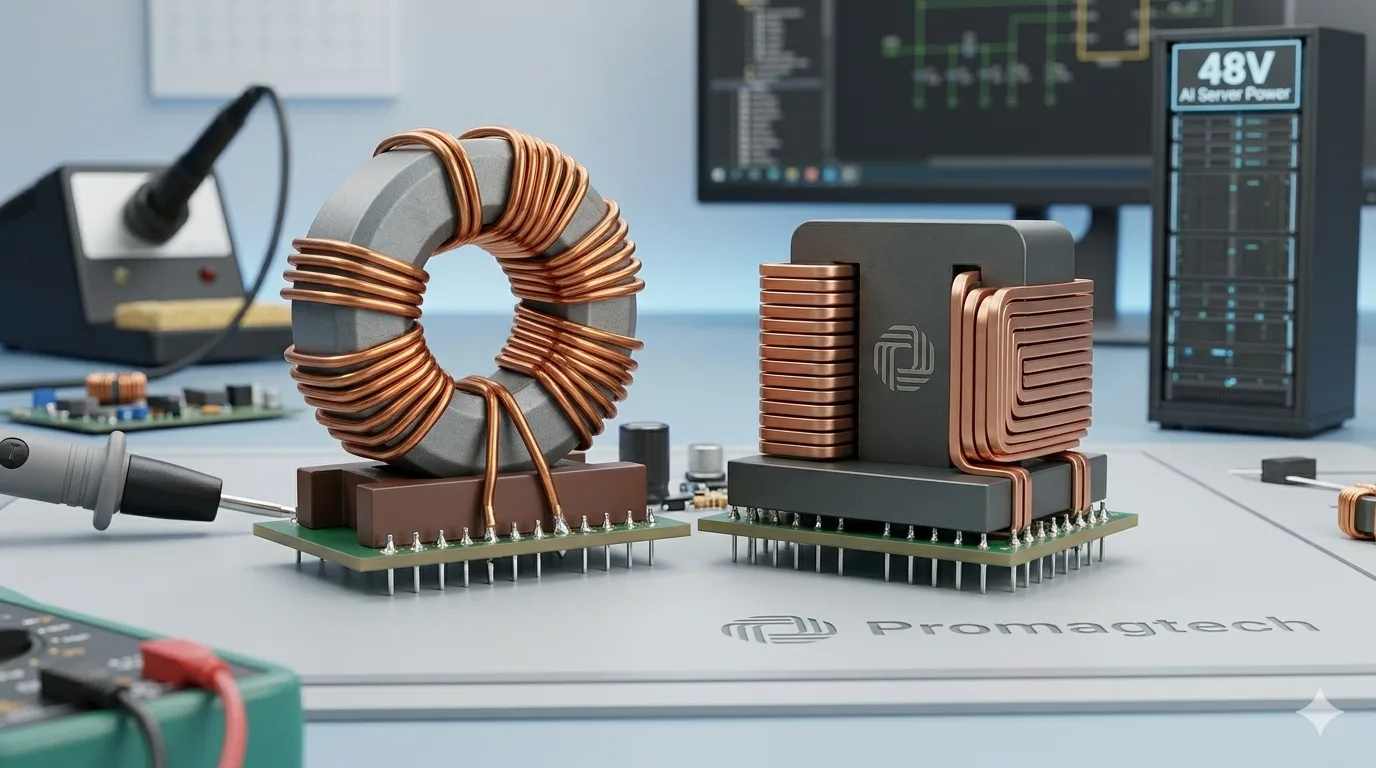
Many hardware and power engineers designing ultra-high-density AI server power supplies still rely on traditional circular wire magnetic components. That choice may be familiar, but it can lock the system into a difficult tradeoff between thermal management, electromagnetic interference, size, and batch-to-batch consistency.
The Silent Limits in Circular Wire Inductors
In high-frequency and high-current power designs, heat is often the failure mechanism that appears after the electrical schematic already looks acceptable. Circular wire windings naturally leave air gaps in the core window because each conductor has a round cross-section. This reduces copper utilization, increases component volume, and can create internal regions with weaker heat transfer.
At switching frequencies around 50 kHz and above, skin effect and proximity effect also become harder to ignore. Under peak current and ripple current, the effective current distribution inside the winding changes, AC resistance rises, copper loss increases, and local temperature rise can become the practical design limit.
Why Flat Wire Changes the Design Margin
Flat wire technology does not remove the need for real thermal validation, but it gives engineers more geometric control over the winding structure. At SHENZHEN PROMAGTECH CO.,LTD, flat wire winding is used to support three practical design goals in high-density power systems.
Rectangular copper can stack more tightly than circular wire, improving core window utilization and helping reduce Z-axis height or total magnetic volume.
A larger copper surface area and shorter heat path can improve temperature distribution when paired with the right insulation, core, airflow, and mounting design.
Flat wire structures are well suited to automated winding and forming, reducing manual variation after the design and tooling are validated.
1. Maximizing Space Utilization
Flat or rectangular copper allows compact stacking that can improve the window fill factor compared with circular wire. In space-constrained AI server power modules, this geometric advantage can free PCB area, reduce magnetic height, and make airflow planning easier.
2. Improving Thermal Management
Flat copper wire provides more exposed surface area for a given conductor section, which can support a more efficient thermal path. In the right design, this helps reduce AC resistance, DCR contribution, and localized temperature rise. The actual improvement must be checked against the converter waveform, airflow, potting, core material, and operating ambient.
3. Raising Production Consistency
Traditional circular wire winding can depend heavily on tension adjustment and operator discipline. Flat wire designs are better aligned with automated winding, closed-loop forming, and repeatable process control. For AI server power systems, this matters because parameter consistency is part of reliability, not only a production convenience.
Get Comparative Data
For engineers comparing circular wire and flat wire solutions in PFC, LLC, DC-DC, and 48V AI server power applications, ProMagTech can review the converter inputs and provide a more focused comparison around inductance, current, frequency, DCR, thermal rise, insulation, mounting, and manufacturability.
Send your electrical parameters, waveform, cooling method, and space limit. We will help evaluate whether a flat wire inductor or custom magnetic structure is the right engineering path.
Download the PDF Data Guide
Download this ProMagTech engineering resource as a PDF for internal design review and supplier discussion.
Download PDF DataRelated Engineering Resources
SMD flat wire inductor
Low-profile surface-mount flat wire inductors for compact power modules.
High power density flat wire magnetics white paper
Round-wire versus flat-wire trade-offs for window fill, AC loss, thermal path and production consistency.
Flat wire inductor selection guide
Compare flat wire and round wire winding for DCR, thermal path, saturation behavior and power density.
Frequently Asked Questions
What is the main engineering decision in The Thermal Bottleneck in 48V AI Data Center Power Architecture?
The main decision is to match electrical stress, frequency, thermal path and mechanical envelope before confirming the magnetic component structure.
Which parameters should be provided for a custom review?
Provide input and output voltage, switching frequency, current waveform, target inductance or turns ratio, temperature limit, insulation requirement and mechanical drawing.
Can the values in this guide be used directly in production?
No. The values are design references. Production values should be confirmed through approved samples, DC bias checks, DCR measurement, hi-pot test and thermal validation.