
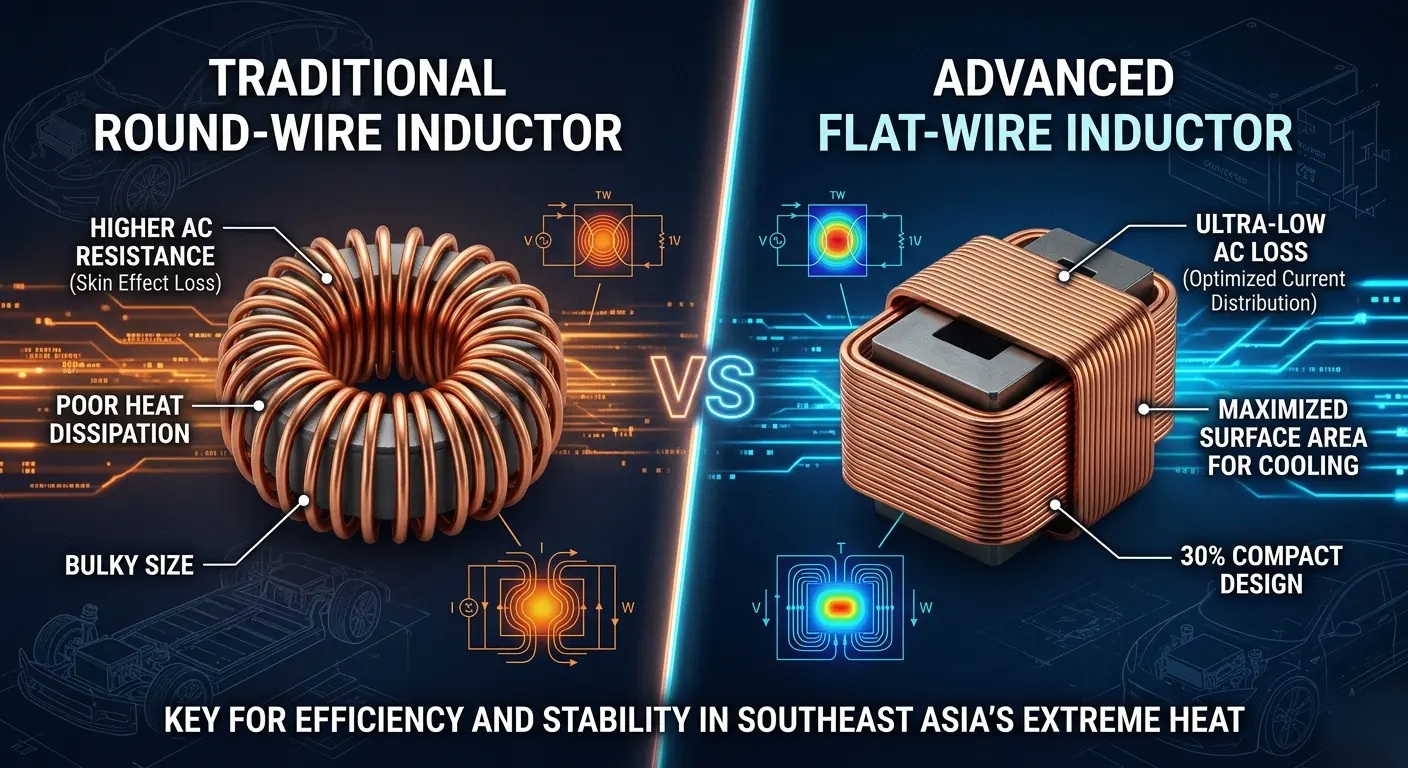
Flat-wire and round-wire designs should be compared under the same core window, turns, conductor temperature, current waveform, frequency, terminals and cooling boundary.
2. Electrical review
Measure DCR at a defined conductor temperature and calculate AC loss from the real waveform or a validated model. Rectangular geometry may improve copper utilization, while layer structure and proximity effect can increase high-frequency loss if they are not controlled.
3. Magnetic and thermal review
Rated current, saturation current and loaded inductance depend primarily on the magnetic circuit, gap, turns and thermal limit. Compare winding options with measured temperature rise and the same mounting and cooling conditions.
4. Manufacturing review
Review winding repeatability, insulation, terminations, forming, soldering, assembly and available equipment. Cost and cycle time are project-specific.
5. Decision record
Use the approved drawing, sample DCR, target-waveform loss, temperature-rise record, DC-bias curve and mechanical envelope. Fixed performance percentages should not be reused without a traceable comparison test.
Download the PDF Data Guide
Download this ProMagTech engineering resource as a PDF for internal design review and supplier discussion.
Download PDF DataRelated Engineering Resources
High current flat wire inductor
Custom high-current flat wire inductors for EV, storage and industrial converters.
SMD flat wire inductor
Low-profile surface-mount flat wire inductors for compact power modules.
120V 40A 66kHz flat-wire inductor case
Review an anonymized high-current design case with DC bias, compact envelope and sample-stage checks.
Frequently Asked Questions
What is the DCR advantage of flat wire inductors over round wire?
There is no universal DCR reduction percentage. Compare both options using the same winding window, turns, conductor temperature, terminals and measurement method.
When should I choose round wire instead of flat wire?
Round wire remains practical when the winding geometry, frequency, available tooling and cost favor it. There is no universal current threshold; compare both conductors under the same electrical, thermal and mechanical conditions.
Does flat wire winding affect saturation current?
Core material, core geometry and air gap determine saturation current. Flat wire mainly reduces copper loss and can free window area for a larger magnetic design.