
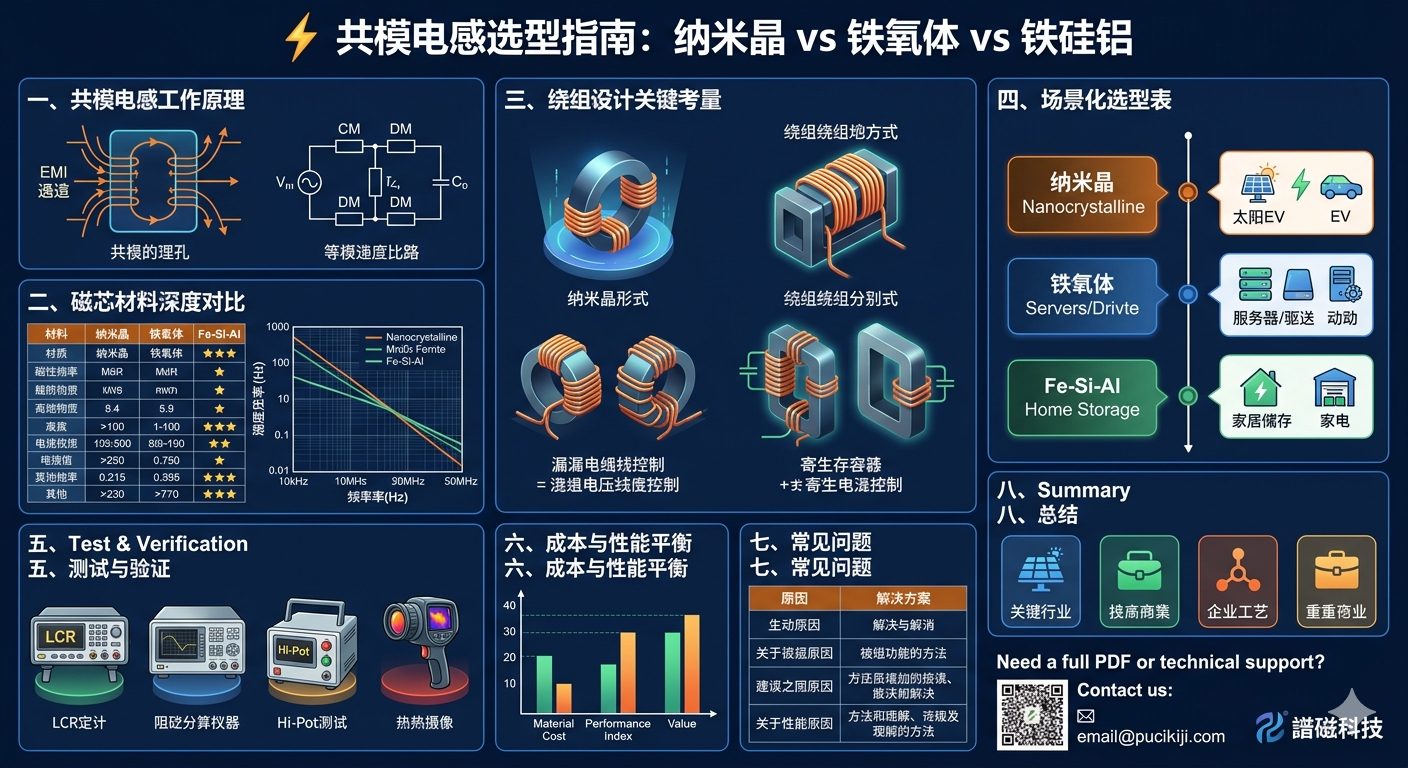
A common mode choke is selected from the measured conducted-noise spectrum, source and load impedance, current waveform, grounding structure and filter topology. Component impedance alone does not demonstrate system compliance with CISPR 32 or another EMC limit.
2. Compare materials over the required frequency band
Ferrite and nanocrystalline materials have different permeability, saturation, loss and broadband impedance behavior. Selection should use supplier material data and an impedance curve for the intended winding, rather than a universal permeability or frequency range.
3. Treat safety values as project requirements
Winding insulation, dielectric withstand, insulation resistance, creepage and clearance are defined by the applicable equipment standard and approved insulation system. Leakage current is a system-level result influenced by Y capacitors, parasitic capacitance and grounding; it is not a guaranteed property of the choke alone.
4. Validate in the final assembly
Confirm impedance or insertion loss on the selected component, then verify conducted and radiated emissions in the final converter layout. Production limits belong in the approved drawing and inspection plan.
Download the PDF Data Guide
Download this ProMagTech engineering resource as a PDF for internal design review and supplier discussion.
Download PDF DataRelated Engineering Resources
Three-phase common mode inductor
Three-phase common mode chokes for inverter and storage converter EMI filtering.
High-frequency amorphous CM inductor
Amorphous-core EMI filter magnetics for SiC/GaN and compact power modules.
Two-stage integrated common mode choke
Integrated EMI choke design for EV chargers, AI server power, solar inverters and storage converters.
Frequently Asked Questions
What is the main engineering decision in Common Mode Inductor Design Guide: Improving EMI Performance?
The main decision is to match electrical stress, frequency, thermal path and mechanical envelope before confirming the magnetic component structure.
Which parameters should be provided for a custom review?
Provide input and output voltage, switching frequency, current waveform, target inductance or turns ratio, temperature limit, insulation requirement and mechanical drawing.
Can the values in this guide be used directly in production?
No. The values are design references. Production values should be confirmed through approved samples, DC bias checks, DCR measurement, hi-pot test and thermal validation.