
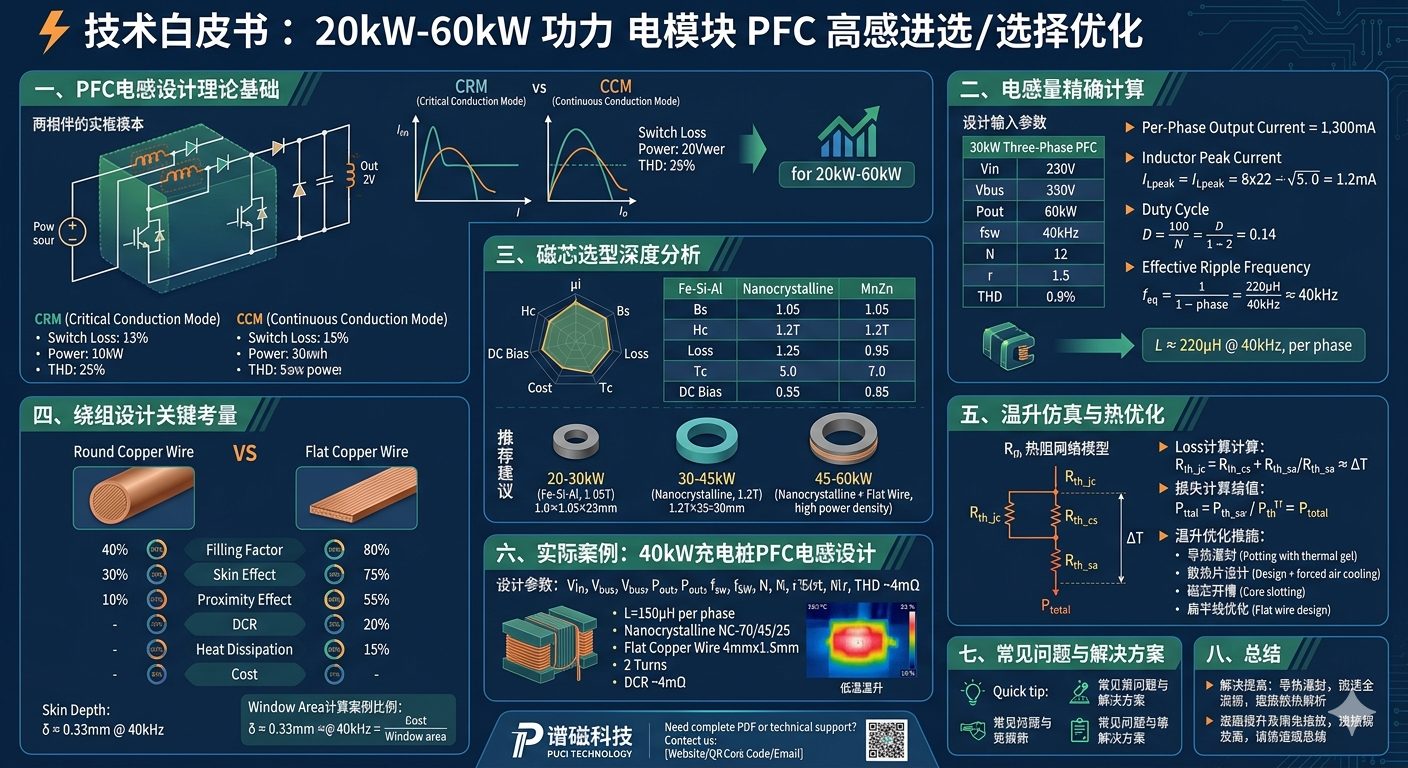
1. Three-Phase PFC Circuit Overview
Three-phase PFC (Power Factor Correction) is widely used in high-power charging stations, energy storage converters, and industrial power supplies. 20-60kW is the mainstream power segment for charging stations, requiring careful PFC inductor design to meet high efficiency, low THD, and high reliability requirements.
2. Inductor Design Basics
Main functions of PFC inductor:
• Store energy, balance input/output power difference
• Limit current ripple, meet THD requirements
• Filtering function, suppress switching harmonics
3. Design Parameter Calculation
3.1 Basic Parameters
Taking 30kW three-phase PFC as example:
• Input voltage: 380VAC (phase voltage 220V)
• Output voltage: 800VDC
• Switching frequency: fs = 50kHz
• Power level: P = 30kW
3.2 Inductance Calculation
Current ripple coefficient usually taken as 0.2-0.4, this design takes 0.3.
Phase current peak: Ipk = √2 × P/(3×Uphase) = √2 × 30000/(3×220) ≈ 64A
Inductor ripple current: ΔI = 0.3 × Ipk ≈ 19A
Minimum inductance: Lmin = (Uphase × D)/(fs × ΔI)
Where D is duty cycle, at 380V input 800V output, D ≈ 0.46
Calculated Lmin ≈ 280μH, considering margin, select L = 350μH
3.3 Core Selection
Core material selection considerations:
• Power loss: Sendust or Permalloy perform excellently in high-frequency PFC applications
• Saturation flux density: ensure sufficient margin under maximum DC bias
• Temperature stability: PFC inductor temperature rise can reach 80-100°C
4. Design Verification
4.1 Temperature Rise Calculation
Copper loss: Pcu = I²rms × DCR
Core loss: obtain from core material and flux density tables
4.2 Insulation Design
PFC inductor两端电压高(800V等级),需注意:
• Winding to core insulation: ≥2mm
• Inter-layer insulation: withstand ≥2× working voltage
• Terminal spacing: meet creepage distance requirements
5. Summary
Key points for 20-60kW PFC inductor design:
• Inductance calculation balances ripple and volume
• Core selection considers both loss and saturation characteristics
• Flat wire winding is necessary for high-efficiency design
• Insulation design ensures 800V platform safety
Ask ProMagTech EngineeringThree-phase PFC (Power Factor Correction) is widely used in high-power charging stations, energy storage converters, and industrial power supplies. 20-60kW is the mainstream power segment for charging stations, requiring careful PFC inductor design to meet high efficiency, low THD, and high reliability requirements.
2. Inductor Design Basics
Main functions of PFC inductor:
• Store energy, balance input/output power difference
• Limit current ripple, meet THD requirements
• Filtering function, suppress switching harmonics
3. Design Parameter Calculation
3.1 Basic Parameters
Taking 30kW three-phase PFC as example:
• Input voltage: 380VAC (phase voltage 220V)
• Output voltage: 800VDC
• Switching frequency: fs = 50kHz
• Power level: P = 30kW
3.2 Inductance Calculation
Current ripple coefficient usually taken as 0.2-0.4, this design takes 0.3.
Phase current peak: Ipk = √2 × P/(3×Uphase) = √2 × 30000/(3×220) ≈ 64A
Inductor ripple current: ΔI = 0.3 × Ipk ≈ 19A
Minimum inductance: Lmin = (Uphase × D)/(fs × ΔI)
Where D is duty cycle, at 380V input 800V output, D ≈ 0.46
Calculated Lmin ≈ 280μH, considering margin, select L = 350μH
3.3 Core Selection
Core material selection considerations:
• Power loss: Sendust or Permalloy perform excellently in high-frequency PFC applications
• Saturation flux density: ensure sufficient margin under maximum DC bias
• Temperature stability: PFC inductor temperature rise can reach 80-100°C
4. Design Verification
4.1 Temperature Rise Calculation
Copper loss: Pcu = I²rms × DCR
Core loss: obtain from core material and flux density tables
4.2 Insulation Design
PFC inductor两端电压高(800V等级),需注意:
• Winding to core insulation: ≥2mm
• Inter-layer insulation: withstand ≥2× working voltage
• Terminal spacing: meet creepage distance requirements
5. Summary
Key points for 20-60kW PFC inductor design:
• Inductance calculation balances ripple and volume
• Core selection considers both loss and saturation characteristics
• Flat wire winding is necessary for high-efficiency design
• Insulation design ensures 800V platform safety
